Recovery Explorer Professional
- Irreplaceable assistant in data recovery for proficient users
- Comprehensive list of supported storage and file system types
- Managing most existing RAID configurations
- Decryption techniques for work with encrypted storages
- Wide range of handled storage technologies
- Support for hybrid and cached storage setups
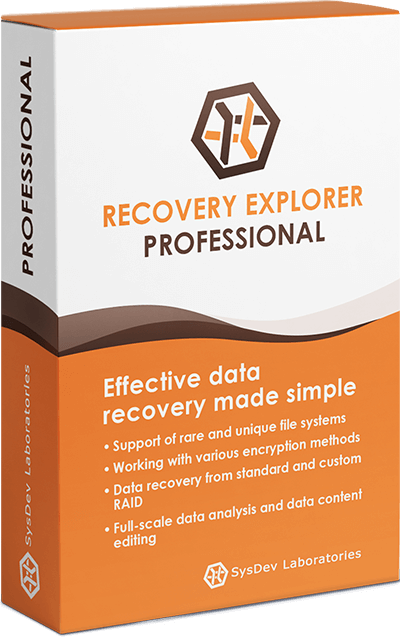
Get an extended data recovery toolkit with Recovery Explorer Professional
Recovery Explorer Professional is robust data recovery software intended for challenging cases of data loss involving complex storage systems, encrypted volumes, and other advanced technologies. It supports a wide range of devices and RAID configurations, including non-standard setups, as well as additional file system and storage acceleration features used by major OS platforms and NAS vendors. The software also works with encrypted storage, supporting widely used encryption technologies such as BitLocker, FileVault, LUKS, VeraCrypt, eCryptfs, and others. At the same time, the utility includes a powerful set of tools for enhanced control over the recovery process and deeper inspection of storage structures. This functionality covers controlled access to storage devices with the ability to save processed data, in-depth analysis and editing of raw hexadecimal content, visualization and decomposition of complex storage layouts, as well as detailed reporting of recovery results. The disk-on-disk recovery technology enables working with virtual disks nested within other storage layers, allowing access to virtual machines and multi-layered disk images without extracting intermediate volumes first.
Recovery Explorer Professional is aimed at experienced users who need professional-level capabilities for their non-trivial data recovery tasks. For more demanding specialized workflows, you may also consider a product with an expanded feature set – UFS Explorer Professional Recovery. A quick comparison of both professional solutions can help you determine which one best meets your recovery requirements.
Typical data recovery scenarios
Recovery Explorer Professional is designed for advanced data recovery tasks, including complex storage systems, encrypted media and low-level data analysis:
- Recovering data from encrypted drives (BitLocker, FileVault, LUKS, VeraCrypt, and others)
- Accessing data when encryption metadata is damaged or incomplete
- Recovering data from complex RAID and NAS configurations
- Restoring files after severe file system corruption or structural damage
- Recovering data from systems using deduplication, acceleration, or other advanced features
- Performing recovery in forensic or investigation scenarios
- Analyzing raw data and file structures at a low level
- Recovering data from virtual machines, disk images, and virtualized storage setups
- Working with damaged or non-standard storage configurations requiring manual analysis
Important note:
For standard data loss scenarios without RAID or encryption, consider Recovery Explorer Standard.
Features of Recovery Explorer Professional
- Data recovery
-
- Local and external hard drives
- Any portable storage media: USB flash drives, SD cards, MicroSDs,
MiniSDs, MMCs, Memory Sticks, etc. - Disk images and virtual disks (including VMware VMDK, Hyper-V VHD/VHDX, QEMU/XEN QCOW/QCOW2, VirtualBox VDI, Parallels, non-encrypted EnCase E01/Ex01, R-Studio RDR)
- NAS units of various brands: Synology, QNAP, Drobo, WD My Cloud, Asustor, TerraMaster, Buffalo and others
- Composite volumes: Windows Dynamic Disks, Microsoft Storage Spaces, Apple Core Storage, Fusion Drive, LVM with thin provisioning
- Hybrid and cached storage systems: Intel Optane Memory products (both M and H series), Drobo with mSATA cache, QNAP with SSD write-cache, Synology with SSD write-cache
- Supported file systems
-
- Windows: FAT/FAT32, exFAT, NTFS, ReFS/ReFS3 (including with enabled data deduplication)
- macOS: HFS+, APFS
- Linux: Ext2/Ext3/Ext4, UFS/UFS2, Adaptec UFS, big-endian UFS, XFS, ReiserFS, JFS, Btrfs, F2FS
- BSD/Solaris : ZFS
- VMware ESX(i): VMFS, VMFS6
- Western Digital: specific instances of Ext4 on WD My Cloud Home, WD My Cloud Home Duo
- Novell: NWFS, NSS, NSS64 (only data access)
- IBM/Microsoft: HPFS (only data access)
- Data access
-
- Immediate access to files and folders
- Instantaneous pre-recovery file system analysis
- Opening custom block devices (SCSI, CD/DVD, RAID, etc.)
- Reporting file/folder allocation information and
direct access to object fragments - Reporting file/folder descriptor disposition and
direct access to its on-disk position
- RAID recovery
-
- Standard RAID patterns: RAID 0, RAID 1, RAID 1E, RAID 3, RAID 4, RAID 5, RAID 6, etc.
- Hybrid RAID Levels: RAID 10, RAID 50, RAID 60, RAID 50E, etc.
- Specific RAID schemes: Drobo BeyondRAID, Synology Hybrid RAID, ZFS RAID-Z, Btrfs-RAID, OpenBSD softraid, etc.
- Custom RAID configurations defined through the RAID Definition Language (RDL)
- Automatic reconstruction of mdadm, LVM, Apple Software RAID, APFS-based Fusion Drive, NT LDM (Dynamic Disks), OpenBSD BIO, Intel Matrix, etc.
- Dedicated tools for processing Microsoft Storage Spaces, Drobo BeyondRAID volumes and ZFS pools
- Contextual on-disk data analysis for RAID assembly
- RAID assembly from disk images/virtual disks
- Virtual decomposition of assembled complex storages
- Building multiple configurations from the same source RAID
- Caching to improve the speed of RAID recovery in case of a small stripe size
- Visualization of the content and layout of the array
- Saving and editing RAID configurations
- Decryption techniques
-
- LUKS encryption
- TrueCrypt/VeraCrypt
- Windows BitLocker
- Apple FileVault 2
- Encryption of Apple APFS volumes
- Encrypted Apple DMG disk images
- Folders encrypted with eCryptfs
- Encrypted VMware VMDK virtual disks
- Full volume/shared folder encryption on NAS units (Synology, QNAP, Asustor and others)
- Password-based encryption on OpenBSD softraid
- Work with disk images and virtual machines
-
- Support for VMware VMDK, Hyper-V VHD/VHDX, QEMU/XEN QCOW/QCOW2, VirtualBox VDI, Parallels HDD/HDS, Apple DMG, sparsebundle, backupbundle, EnCase E01 and Ex01 non-encrypted files, simple disk images
- Opening a set of disk image chunks as a spanned storage
- Handling a physical drive as a disk image (for XEN and others)
- Support for Synology Sparse iSCSI
- Support for R-Studio image files (RDR file format)
- Support for "split" disk images created by DeepSpar DDI
- Support for disk images created by MRT data recovery tools (sorting and combining file image chunks into an image file)
- Opening a disk image file directly from the file system
- Scanning
-
- Instant detection of lost partitions
- Automated partition aligning
- Possibility to define lost partitions manually
- Search for the missing LVM volumes
- Full-range storage scan for all-at-once data recovery
- Possibility to choose the way of handling the existing file system
- IntelliRAW™ with custom rules for data recovery by known content
- The options of pausing and resuming the scanning procedure
- Preview of intermediate scan results
- Saving a file with the results of a scan for further work
- Optional saving of the scan status within the defined period
- Visualization of the scanning process
- Additional functions
-
- Configurable disk reading
- Read-once disk access with saving of processed data
- Built-in basic disk imager
- On-the-spot preview of files (images, documents, videos, archives, etc.)
- Indication of validity for files in scan results
- Quick and advanced file search
- Saving files in accordance with the applied filter
- Creating advanced “tasks” for saving files
- Evaluation of the size and consistency for the data
- Building basic and interactive HTML-reports
- S.M.A.R.T monitor for drives
- Logging of events occurred during work with the program
- Integrated manager for custom IntelliRAW™ rules
- Hexadecimal analysis
-
- Hexadecimal viewer for storages, partitions, files, file fragments
- Hexadecimal editor for storages and partitions
- Parity calculator
- Field highlighting
- Data interpreter
- Hexadecimal preview of folder structure
- Storage content comparison
- Hexadecimal parallel data search tool
- Byte-level storage span builder
- Data allocation tracing through reverse address translation
- Indication of used file system space
Technical data
- Host operating systems
-
- Microsoft Windows ®: Windows ® XP with Service Pack 3 and later
- Apple macOS: version 11 and above
- Linux: most modern Linux distributions (software API requires ld-linux.so.3, libstdc++.so.6, libX11.so.6, libpthread.so.0)
- Not supported: iOS, Android, Windows RT, Windows Mobile, etc.
- Host CPU architectures
-
- AMD64 (x86-64)
- Intel Architecture, 32-bit (IA-32, x86)
- Apple Silicon (arm64)
- Trial software limitations
-
- The software copies files, the size of which doesn’t exceed 768 KB
- "Save" and "Copy" functions, of certain hexadecimal viewer/editor dialogs are disabled
- Licensing and maintenance
-
- Unlimited in time usage of a licensed version
- 360 days of free software updates
- Personal, Corporate and Commercial licenses are available, each granting specific rights of software use.
- * Apple HFS+/ Ext2-Ext4: A limited number of files can be recovered with their original names due to the specifics of the file systems
- * UFS/UFS2: Very limited support for deleted data recovery
- * Oracle/SUN/FreeNAS ZFS: Recovery after file system damage and deleted data recovery is only available for simple, mirror, stripe and span volumes
- * VMware ESX VMFS: Limited support for deleted VMDK files recovery
Pricing
- Trial license
- Free
- Personal license
- $209.95
- Commercial license
- $539.95
- Corporate license
- $929.95